There is a place in the mountains of Montenegro that, for most of human history, no one had ever walked through. People knew it was there. Shepherds watched the Komarnica River vanish into a black slit between two massifs and reappear, calmer, somewhere downstream. But the inside of that slit, the corridor of cold water and vertical limestone, stayed a rumour. The locals had a name for it that says everything you need to know: Neviđio, the unseen.
This is the story of how that name came to be, why the canyon held out against explorers when so much of Europe had already been mapped and measured, and how a group of mountaineers from Niksic finally walked into the rumour in 1965 and came out the other side. If you have ever wondered why Nevidio Canyon is so often called the last conquered canyon in Europe, you are about to get the full picture, history, legend, geography, and all.
What "Nevidio" Actually Means
The full local name is Neviđbog, and it carries a piece of folklore inside it. Roughly translated, it means something close to "God has not seen it." The story passed down around Šavnik is that until 1965, people would say that even God had never laid eyes on the canyon's interior. The shorter, more common tourism spelling, Nevidio, keeps the core of that idea: the unseen, the not-seen, the invisible.
The name is not poetic exaggeration. It is a literal description of how the place behaves. The river effectively disappears into a deep, narrow cleft that is, for long stretches, invisible to anyone standing above it. You can be metres from the canyon and never know the scale of what is below your boots. That quality, a major river hiding in plain sight, is exactly what kept the Neviđio Canyon off the map of explored places for so long.
Where the Canyon Hides
To understand why it stayed unseen, you have to understand where it sits. Nevidio Canyon was carved by the Komarnica River, specifically its upper reach, draining the great Durmitor massif. It cuts a path along the southwestern edge of Durmitor National Park, wedged between the Durmitor and Vojnik mountains, near the small town of Šavnik. It also falls within the protected Dragišnica i Komarnica Nature Park.
This is not a roadside attraction. The staging village, Pošćenje, sits roughly ten kilometres from Šavnik and around thirty kilometres from Žabljak, the usual tourist base. From Niksic, the city whose mountaineers would eventually claim the first traversal, it is about an hour's drive. You leave the main road, follow a track to Pošćenje, and walk a short approach to the canyon mouth. Even today, with guides and gear and a known route, getting there takes effort. A century ago, with none of that, the canyon's geography alone was a fortress.
The limestone here is classic karst country. Over an immense span of time, the cold river ground its way down through soluble rock, incising near-vertical walls, tight corridors, waterfalls, cascades, and deep pools. The result is a corridor of stone where the river runs the show and the human visitor is, at best, a guest.
The Reputation: Europe's Last Conquered Canyon
The phrase you will see again and again, on tour pages, in travel articles, in casual conversation in Montenegrin cafes, is that Nevidio was the last conquered canyon in Europe. Some versions narrow it to the Balkans or to northern Montenegro. It is worth being honest about this claim: it is universally repeated, but its literal accuracy is not rigorously documented. Think of it less as a measured historical fact and more as a reputation the canyon earned and never lost.
What is genuinely true is why the reputation stuck. This is terrain that defeated capable, determined people more than once before it yielded. The legend grew because the difficulty was real.
How to read the claim
If a friend asks whether Nevidio was "really" the last canyon in Europe to be explored, the honest answer is a confident maybe. The claim is repeated everywhere, the underlying difficulty is well attested, but no one has produced a definitive register of European canyon conquests to prove it. Enjoy the story, respect the substance behind it, and hold the superlative lightly.
The 1965 Traversal
For all the mystery around the place, the moment of its conquest is reasonably well documented.
The first successful traversal happened in August 1965. It was achieved by the mountaineering club Javorak, based in Niksic. Importantly, the credit belongs to the club collectively, not to any single hero. This was a team effort, and the sources are consistent on that point. The party most commonly described numbered eight mountaineers and three cameramen, equipped with both diving and mountaineering gear, which tells you something about the mixed challenge ahead of them: part climb, part swim, part descent into the unknown.
The traversal took two days, with a night spent on the cliffs above the canyon. Picture that: a team committing to a route they could not fully see, sleeping on a ledge above a river that had turned back everyone before them, then dropping back in the next morning to finish what they started.
The attempts that came before
The 1965 success was not a first try. Earlier expeditions in 1957 and 1964 had attempted the canyon and failed, beaten back by inadequate equipment and high water. Some accounts describe a span of attempts across those years. Each failure added to the canyon's mystique and confirmed the old saying about a place even God had not seen. When Javorak finally made it through, they were not just walking a river. They were closing a chapter that had stayed open far longer than anyone expected.
Why It Resisted Exploration So Long
So what made this short stretch of river, only a few kilometres long, hold out when so much of the continent had been thoroughly explored? Three things, mostly.
- The water. The canyon is fed by snowmelt and rainfall, and for much of the year the flow is too high, too fast, and too cold to attempt. The river only becomes passable once levels drop in summer. Early expeditions ran straight into walls of water they could not get past.
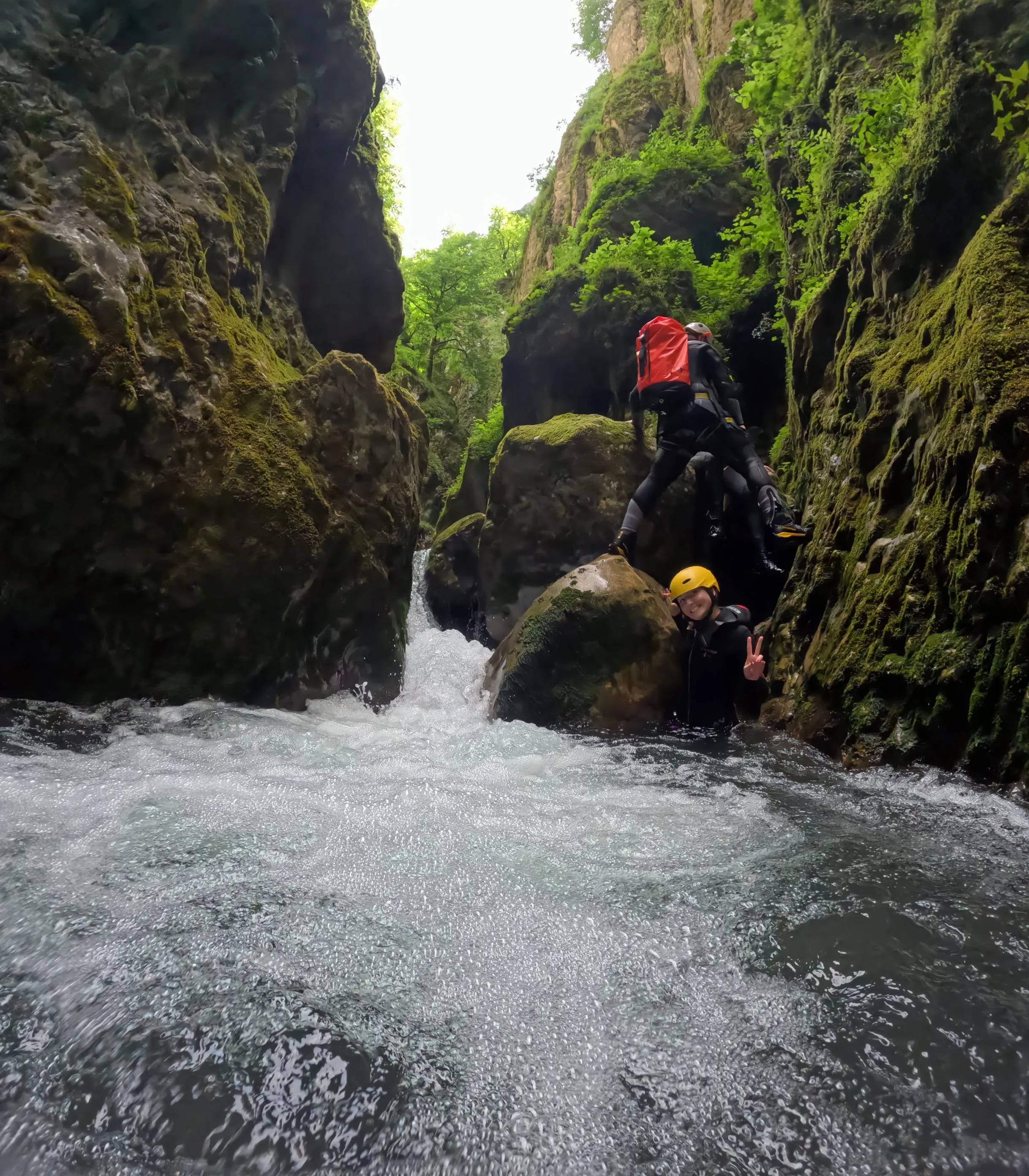
- The narrowness. Many passages squeeze to under a metre. The tightest point, in a section nicknamed the Kamikaze Gate, narrows dramatically, with the most extreme figure cited at around 25 centimetres across an eighty-metre passage. In high water, those slots become impassable funnels.
- The one-way nature of the route. This is the detail that turns difficulty into genuine danger. Once you enter Nevidio, the only way out is the far, downstream end. You cannot turn back. For early explorers without modern ropes, wetsuits, and rescue knowledge, committing to a corridor with no retreat was an enormous gamble.
Stack those together and the canyon's long resistance makes complete sense. It was not unexplored because no one cared. It was unexplored because, until the right combination of people, season, and equipment came along, getting through and getting out was close to impossible.
Cultural Significance: More Than a Sporting First
The 1965 traversal matters to Montenegro in a way that goes beyond mountaineering records. Conquering a place named "the unseen," a place woven into local sayings about the limits of even divine knowledge, carried real symbolic weight. A homegrown club from Niksic had done what generations had assumed could not be done. The canyon shifted in the cultural imagination from forbidden ground to a source of regional pride.
That heritage is part of what makes a trip here feel different from a standard adrenaline outing. You are not just splashing through a pretty gorge. You are following, with far better gear, the line that a small team of locals first traced into the unknown. For a fuller sense of what surrounds you, the natural backstory in the geology, wildlife, and natural wonders of Nevidio Canyon is worth reading before you go.
How History Shaped Today's Canyoning Experience
The modern canyoning experience in Nevidio is, in a real sense, a guided re-enactment of that first passage, minus the uncertainty about whether you will make it out.
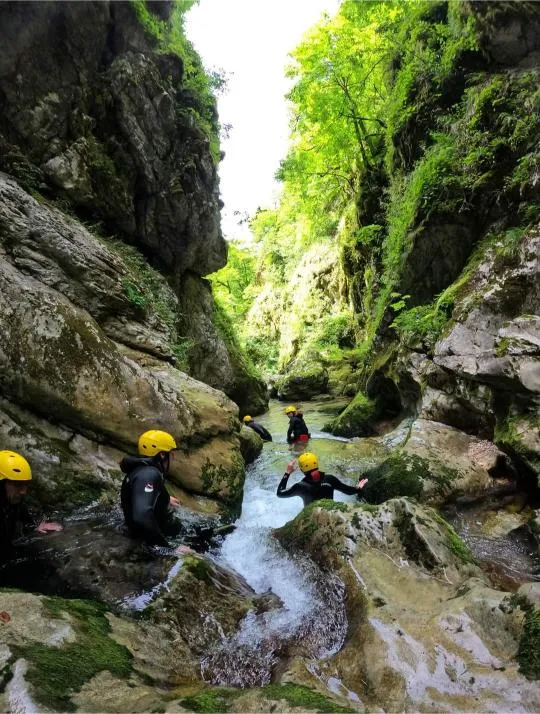
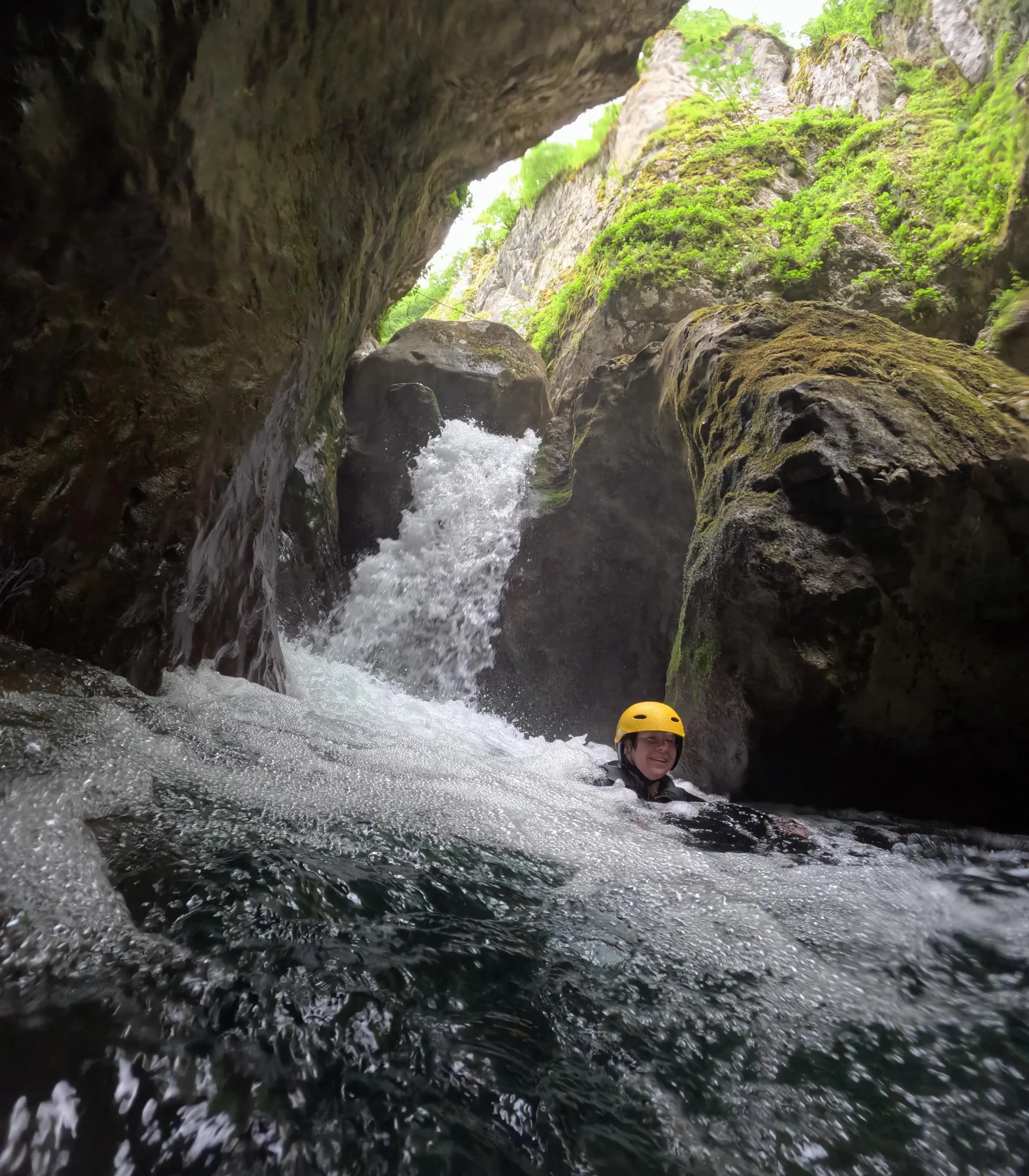
Today the canyon is one of Montenegro's premier adventure-canyoning destinations and a flagship of adventure tourism Montenegro as a whole. Our trip means swimming through pools, wading, scrambling and downclimbing, abseiling down rope descents, riding natural water slides, optional jumps, and squeezing through those famously tight passages. The water stays genuinely cold all year, commonly cited at around five to ten degrees Celsius in summer, which is why we provide a full neoprene wetsuit for every guest as standard. You spend roughly two and a half to three and a half hours inside the canyon, followed by a climb out of around forty minutes, with the whole trip running about five to eight hours including transfer and gearing up.
The tour costs a flat €120 per person, and that price includes a licensed guide, a full neoprene wetsuit, canyoning shoes, neoprene socks, a complete harness, a helmet, all taxes, and the photos and videos from your day. The experience is guided-only, which is non-negotiable. The same one-directional terrain that made early attempts so risky means our guides assess water level and weather before every entry and cancel in bad conditions. The reasons the canyon resisted exploration are precisely the reasons you do not enter it alone.
The season runs roughly from late May or June through to late September. The minimum age is around twelve, with a guardian required for anyone under eighteen, and basic swimming ability is recommended. If you are a weaker swimmer, our guides assist you through the deeper pools with a life jacket and rope, so you are never left to manage the cold water alone.
If you are weighing up whether this is your kind of adventure, a few companion guides go deeper than I can here:
- For the full practical overview, start with the complete guide to Nevidio Canyon.
- If it will be your first time, what to expect on your first visit walks you through the day.
Canyoning in Montenegro has plenty of options, but few carry this much story. Among the many things to do in Montenegro and its long list of nature attractions, Nevidio canyoning stands almost alone in combining serious extreme sports Montenegro thrills with a genuine sense of walking into history.
Quick Facts: Nevidio Canyon at a Glance
| Detail | What the record says |
|---|---|
| Name meaning | "The unseen" / "not seen" (from Neviđbog, "God has not seen it") |
| River | Komarnica River, draining the Durmitor massif |
| Location | Southwestern Durmitor National Park, near Šavnik |
| First traversal | August 1965, by the Javorak mountaineering club of Niksic |
| Earlier failed attempts | 1957 and 1964 |
| Canyon length | Genuinely contested; roughly 2 to 3.8 km depending on what is measured |
| Water temperature | Cold year-round, commonly cited around 5 to 10 °C in summer |
| Season | Core window June to late September |
Ready to Walk Into the Unseen?
Some adventures are just a checklist item. This one is a chance to follow a route that defied explorers for generations and was finally traced by a handful of determined locals in 1965. The water is still cold, the walls still rise close enough to touch, and the canyon still earns the name that means "the unseen." Come see what God supposedly could not.